The best projects we have worked on were not necessarily the ones with the largest teams. They were the ones where the right people joined at the right moment, solved the right problem and helped the project keep moving.
Sometimes that means hiring internally. Sometimes it means partnering with another agency. Sometimes it means bringing in external expertise for one specific challenge, such as a Shopware migration, a complex integration or a performance issue that needs focused attention.
Flexibility matters when budgets are watched closely
Many companies are more careful with long-term commitments today, but the pressure to deliver has not disappeared. Ecommerce teams still need stable platforms, faster releases, better integrations and reliable delivery. Flexible partnerships make it possible to add capacity without permanently changing the shape of the team.

Where external development support works best
Specialized problems
External support is useful when the challenge needs deep experience, such as Shopware development, ERP connections, payment flows, custom plugins, migrations or performance optimization.
Delivery pressure
It also helps when an agency or in-house team has a clear roadmap but not enough development capacity to deliver everything on time.
This is where we increasingly see agencies, freelancers and specialized development partners working together instead of competing for the same space. A good partner does not replace the core team. They extend it, bring calm execution to a defined part of the project and leave the client with a stronger system.
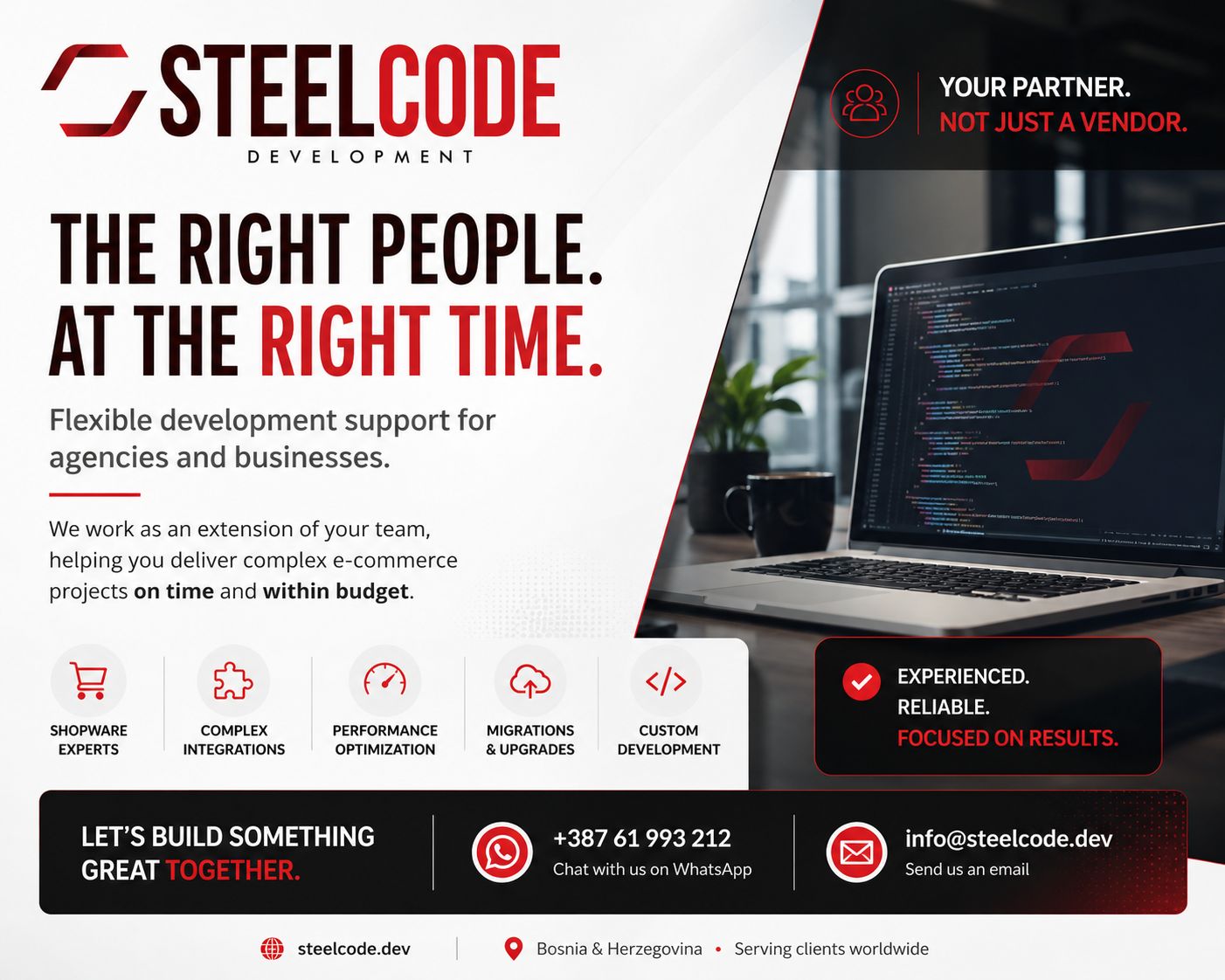
At SteelCode, we have been working more often alongside agencies and in-house teams as an extension of their development capacity. The work usually sits around Shopware, complex integrations, migrations, performance optimization and helping projects reach the finish line without lowering technical standards.
The partnership model is changing
Over the next few years, we expect this kind of collaboration to become more common. Companies will still build strong internal teams, but they will also want access to focused expertise when the timing, scope or complexity of a project calls for it.
The question is no longer whether everything should be done in-house or outsourced. The better question is: who needs to be involved right now to make this project successful?