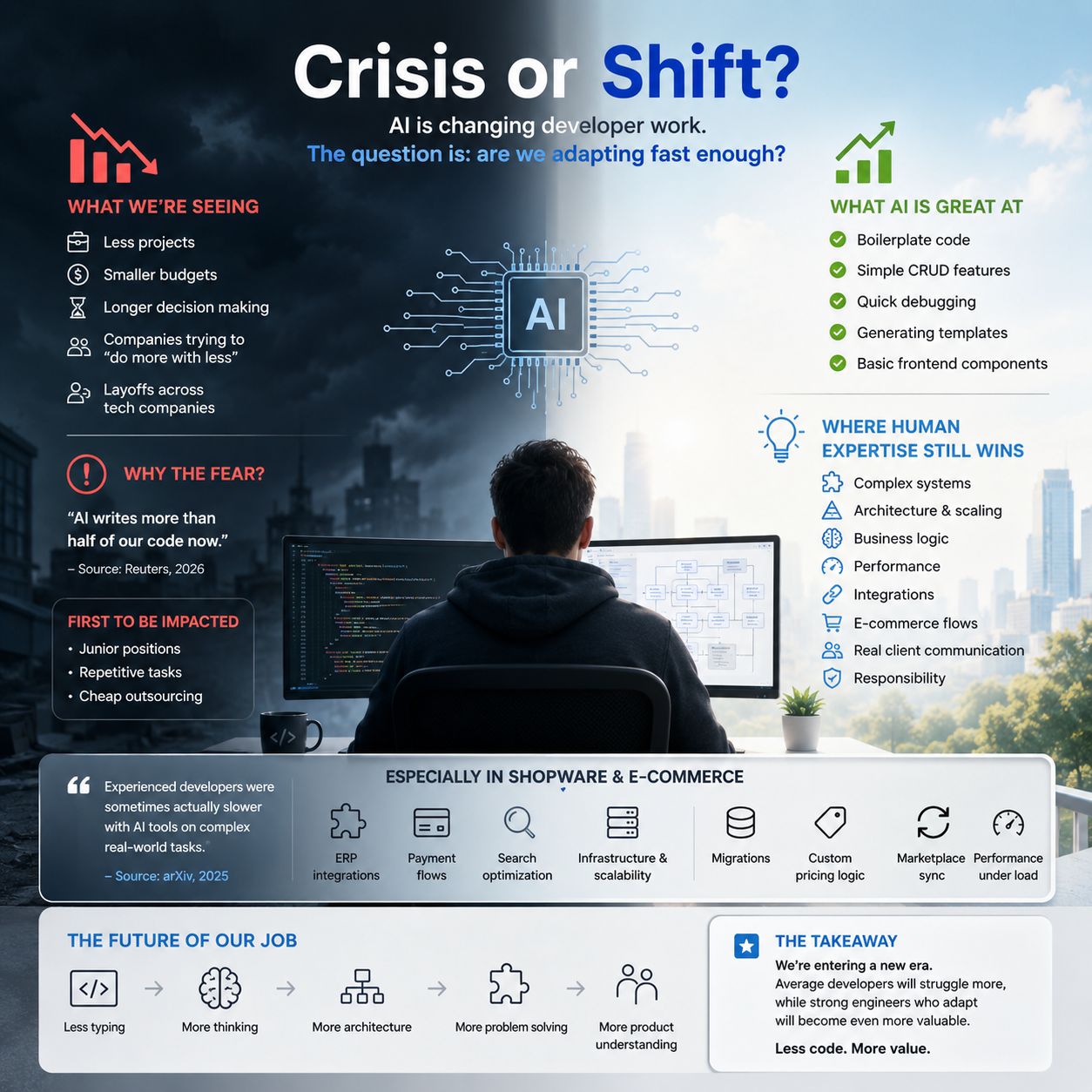
The market feels strange right now. Not only in the Shopware ecosystem, but across software development in general. There are fewer projects, smaller budgets, longer decision-making cycles and more companies trying to do more with less.
At the same time, AI sits in the middle of almost every conversation. We see layoffs across tech companies while also hearing that AI now writes a large part of the code in some teams. It is natural that this creates fear in the developer world.
Development is not dying. Low-value development is.
AI is very good at speeding up repetitive work: boilerplate code, simple CRUD features, quick debugging, templates and basic frontend components. That absolutely affects junior positions and cheap outsourcing first, because those areas are easiest to automate or compress.
Where AI helps
Repetitive implementation, first drafts, component scaffolding, syntax help, debugging support and faster exploration of options.
Where engineers still matter
Architecture, scaling, business logic, performance, integrations, ecommerce flows, client communication and responsibility for production systems.
Complex real-world work is still different. Recent research has even shown that experienced developers can sometimes become slower with AI tools on complex tasks, because reviewing, correcting and integrating generated output takes real effort.
Ecommerce needs more than someone who writes code
What we notice in ecommerce is that clients rarely need only another person who can code. They need someone who understands how the business works, how systems connect and what can break when a decision looks small but affects checkout, inventory, pricing or performance.
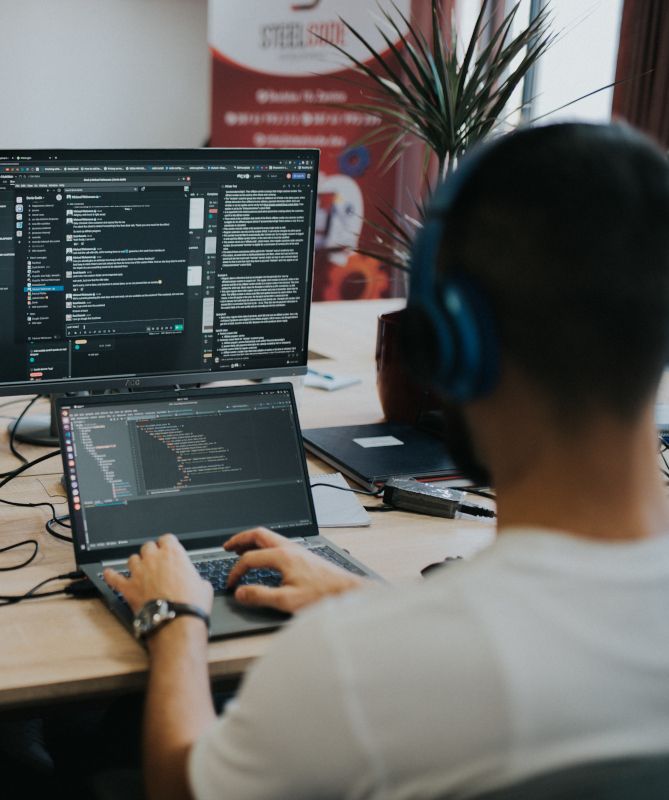
AI can assist, but responsibility stays with engineers
In Shopware projects, the hard parts are often ERP integrations, payment flows, search, infrastructure, scalability, migrations, custom pricing logic, marketplace sync and performance under load. AI can help with parts of that work, but it does not own the outcome.
The job is shifting
We are entering a period where average developers will struggle more, while strong engineers who adapt will become more valuable. The job is moving away from just typing code and toward thinking, architecture, problem solving, product understanding and communication.
The just write code era is slowly disappearing. That may be uncomfortable, but it may also push software development toward better work: less mechanical output, more responsibility and more focus on solving the right problem.